KOSPI Crash Sparks Debt-Fueled Investment Drop Below 30 Trillion
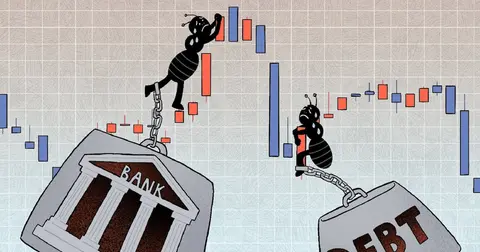
July forced liquidations hit 992.8 billion won as KOSPI crash forces debt-fueled investment cuts The KOSPI plummeted over 10% in a single day, marking historic volatility last month, while the scale of domestic "debt-fueled investment" (investing with borrowed money) fell below 30 trillion Korean won for the first time in six months. According to the Korea Financial Investment Association on August 4, the balance of domestic credit transaction loans stood at 28.935 trillion Korean won as of July 31. The scale of debt-fueled investment, which had exceeded 38.6 trillion Korean won as recently as June 22, shrank by nearly 10 trillion Korean won in about a month. This marked the first time the balance dropped below 30 trillion Korean won since January 28.
Analysts attribute the decline to the collapse of Samsung Electronics and SK Hynix -- the "top two" stocks in the domestic market -- by half from their peaks, and the KOSPI's 10.8% single-day plunge (on July 28), which led individual investors to reduce their debt-fueled investments. The surge in forced liquidations, where securities firms sell off stocks to recover loans, also contributed. According to the Korea Financial Investment Association, the value of forced liquidations due to overdue entrusted trading payments reached 992.8 billion Korean won in July. Overdue payment transactions involve investors borrowing money from securities firms for short-term stock purchases.
If the debt is not repaid within two days, the firm forcibly liquidates the stocks on the third business day (T+3) to recover the loan. The KOSPI's sharp decline -- from 7,096.89 on July 23 to 5,593.56 on July 30, a drop of over 1,500 points in five trading days -- triggered a spike in forced liquidations. Indeed, the value of forced liquidations due to overdue entrusted trading payments surged from 13.9 billion Korean won on July 28 to 61.1 billion on July 29, 103.8 billion on July 30, and 122 billion on July 31. A financial investment industry official said, "The strong market turbulence has materialized 'debt-fueled investment liquidations,' and individual investors, gripped by fear, appear to have reduced their debt-fueled investments.
The KOSPI rallied in the first half of this year thanks to buying momentum from individual investors, but whether it can regain momentum toward 9,000 again depends on the recovery of their investment sentiment."