Warhammer 40,000: Mechanicus II - Review
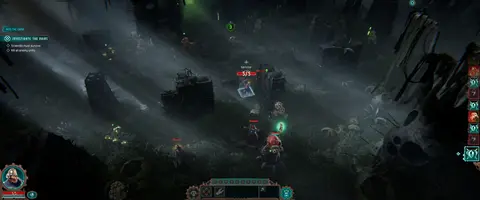
It sometimes happens that I play a sequel and feel frustrated by what I've experienced. This dystopian sequel to a fantastic predecessor is a prime example of that. There is an adventure beneath the surface that is genuinely good, which is why it's a bit of a shame that the developers have occasionally chosen the wrong path to take. Mechanicus II does exactly what all sequels do, ramping up the pace, scale and grandeur.
It does so somewhat at the expense of its unique character as a Warhammer 40K strategy game. Once again, we're treated to a vibrant soundtrack that's fantastic, with a lovely mix of phenomenal sound design. This time, we'll once again be issuing orders to the Adeptus Mechanicus and the Necrons. However, not everything is as it seems, and much has changed since the first time we got to plunder ancient high-tech bases from a bygone era.
The first thing that stands out is that there are now two campaigns. Both offer you a distinct perspective on the same conflict. The Adeptus Mechanicus settles on a world that happens to be a resting place for the Necrons - a form of high-tech machines reminiscent of the pharaohs of Egypt. Vargard Nefershah has awoken and is attempting to mobilise his forces against what he sees as intruders.
This sparks a massive conflict that engulfs the entire planet. It falls to you to resolve the situation, either as the intruders or as the original settlers. Both campaigns are entertaining, each offering a unique perspective on the conflict. I started as the Adeptus Mechanicus, which allows us to see some familiar faces from the previous game.
This time, we're designated as shock troops and our job is to strike targets that no one else can reach quickly enough. The first thing that struck me was that everyone spoke English, which is a complete departure from the previous game. However, it was easy to change the settings so that they spoke the code language, just like in the previous game. The same does not apply to the Necrons, though; they speak English with an accent.
I would have liked to see them given their own language in the same style. One of the biggest changes is your input and how the battles work. In this game, you choose a hero from the Adeptus Mechanicus. They are all designed with different abilities and upgrade trees.
This means that after missions, you can choose how to develop these characters. Each mission involves selecting a hero and then unnamed troop types with different abilities. This is also my main criticism; I would have preferred more heroes with more dialogue and comments to each other during the missions. You have a certain number of troop types to choose from, and these can be upgraded via a technology tree.
This is also where you unlock more and stronger soldiers. To do this, you need special resources obtained through missions, mission modifiers, and buildings in the campaign world. I like the resource management system; you really need to think about how much you spend on each mission so that later missions don't force you to use only troop types that are free. It can be disastrous for a campaign if you lack the ability to recruit more advanced troop types.
When you start a mission, your character begins moving after a short intro. You have no control over the action; instead, you watch a timeline showing when events and battles will occur. In my opinion, this is a mistake. One of the great joys of the first game was being able to choose rooms, avoid traps, explore the environments and sometimes avoid battles altogether.
In the sequel, everything is even more scripted and on rails. This also means that the chances of survival and mission failure increase. You cannot avoid the battles and must therefore make the most of events and avoid costly losses during the mission. You also need to keep an eye on a gauge which, if it fills up, results in more enemies in the next battle.
If your troops are wounded, the battle can become unnecessarily difficult. The battles are slightly different from the first game in that you have more troop types on the battlefield and fewer heroes. Because the battles don't offer the same complexity as their rivals, such as XCOM 2, they quickly become repetitive. As mentioned, battles are unavoidable and frequent.
The battles themselves aren't bad, but there are simply too many of them. I believe Mechanicus II would have been better served by fewer but more significant battles and more events during the missions. However, you can utilise the terrain in a way the first game never allowed, and both factions play so differently that it remains entertaining nonetheless. And let's not even get started on the Leagues of Votann, who appear quite early in the campaign.
These creatures with highly advanced technology are quite entertaining, and I hope an expansion to the campaign will let us play more as these unique space dwarves. It might sound as though I'm dissatisfied with the campaign, but it does have its good points too. I enjoy building up the planet and trying to gather more resources. I like being able to let heroes handle certain things on their own.
This means you have to manage your key characters carefully and choose which ones are best suited to send out. They're often away for a round or two, which makes the choice important. I like upgrading my characters and unlocking troops. On the surface, it feels like a board game in some respects.
Although the doomsday clock isn't present in the same way as in the first game, the music, dialogue and characters all make the situation feel critical. If there's one thing that deserves praise once again, it's the music designers, sound designers and 3D artists, including those behind the voices, design, music and sound. It both looks superb and sounds fantastic. Not having voice acting was a way to save money in the first game, but Bulwark Studios did such a brilliant job of giving these characters and this faction a voice that I can't imagine it any other way.
They really captured the essence of what the Adeptus Mechanicus is and how they sound in their game. This works just as well, of course, in the sequel. Sometimes I even think they sound a bit better. Technically, just like the first game, this runs smoothly on a computer and boasts sharp graphics.
The detailed characters and user-friendly interface contribute to a great experience. It's hard to go wrong, and there are tips for just about everything you could think of in the menus should you need them. The game has so few menu layers that I wouldn't call it a difficult strategy game. The hardest part of the game is that some campaign missions vary quite a lot in terms of difficulty.
Some early missions are significantly harder than some later ones. Despite this, I didn't encounter any notable bugs. The only thing I came across was a sound glitch where the character skipped a line of dialogue. Looking at the bigger picture, we have an adventure where each campaign takes well over 20 hours, depending on the difficulty level and how many extra side missions you undertake.
Depending on how things go, you may also have to play defence missions as your opponent doesn't stand still on the campaign map. These can extend the playtime slightly. You're also treated to fantastic sound design and beautiful graphics with an easy-to-use interface and detailed visuals. It's hard not to get swept up in this conflict between two mechanical factions.
I love the dichotomy in what these two superpowers believe in, even though they are both more mechanical than organic. There are also several other factions that make shorter and longer appearances during the campaigns. Some of these even make your own characters feel weak in comparison. Mechanicus II isn't bad, but it makes certain choices that I feel detract from the experience rather than elevate it above its predecessor.
My main criticism is that everything feels too scripted in a way that I felt the predecessor avoided by giving you more freedom in how you move through the various buildings on the campaign map. The choices in the sequel have been moved from the missions to the campaign map between these missions. Above all, some of the mystery is lost if you know when everything happens - for example, battles, events with multiple choices and other elements during a mission. This is probably not something that will change, as it is fundamentally tied to the basic structure of the campaigns.
The story itself is interesting, well-crafted on both sides, and features a couple of factions that are currently being heavily promoted by Games Workshop. I love moving Necrons around the battlefield. They're a real joy to play as, no matter where they turn up. Despite complaints about the structure, I like the game even if it isn't perfect.
The developers are trying to experiment and improve on their core design from the first game. Looking back, it turns out they haven't quite succeeded fully. However, I would argue that it succeeds well enough to give it a go if you enjoyed the predecessor. Although the Necron campaign could have had slightly more interesting upgrade trees, the battles are a bit too frequent and the missions are on rails, the package as a whole is more than passable.