Is this really the way the world ends? | Resident Evil : The Final Chapter Revisited - HeadStuff
Thirty years ago, Shinji Mikami's landmark videogame Resident Evil released, immediately ushering in a new era of horror. Countless games and films tried in vain to imitate Mikami's strange alchemy of puzzle-solving, horror, and action. Meanwhile, publisher Capcom wasted no time in franchising the game, rolling out a sequel within two years. The Resident Evil saga now spans over thirty games, seven (soon to be eight) live-action films, and countless other spin-offs, including television shows, animated films, and tie-in novels and manga.
As the series gears up to celebrate its thirtieth year, join us at HeadStuff as we revisit Paul W.S. Anderson's ambitious six-film adaptation of the franchise. We'll look back at one film a week, counting down to the release of the next videogame installment, Resident Evil 9: Requiem, releasing February 27 2025. "This is the way the world ends, this is the way the world ends, not with a bang but a whimper." So concludes T.S.
Eliot's poem "The Wasteland". For all its ironic portent of a downbeat and understated apocalypse, at least Eliot allows for the satisfaction of finality. In Resident Evil The Final Chapter, no such climactic satisfaction awaits. In fact, very little satisfaction whatsoever awaits - dramatic or otherwise.
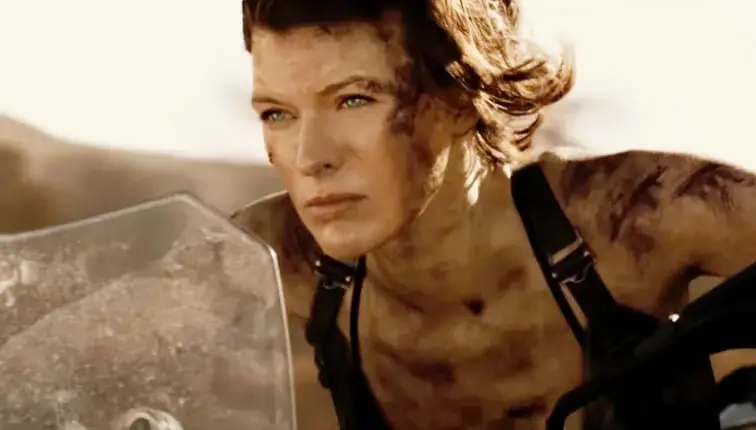
Retribution, in all its messy ambition, ended with a bang and a promise. In my write-up of that film, there was so much to discuss that I even neglected to touch upon the film's ending, which provides the series' greatest cliffhanger. After escaping Umbrella once again, Alice (Milla Jovovich, one last time) and her allies meet with Albert Wesker (Shawn Roberts, who has found his villainous groove) at the White House. At the final requiem for Anderson's post-apocalypse, Alice, Leon (Johann Urb), Ada (Bingbing Li), and Jill (Sienna Guillory) desperately held fast with their archenemy in Washington D.C., seemingly the final bastion of humanity.
Innumerable hordes of the undead shambled forward as the camera panned out, and the dramatic potential of a movie-length final siege was left dangling for audiences. In the interim period of four years (during which Anderson directed the interminable Pompeii), fans could be excused for expecting the largest-scale Resident Evil to date. The Red Queen from the first film was back as a villain, providing a neat - if convoluted - symmetry to the series. The stage seemed set for a conventionally satisfactory final battle.
Instead, The Final Chapter elects to begin with the dust of the siege long settled, Wesker a villain again, and the Red Queen exonerated. It's a frustrating beginning that resets the status quo: since Extinction, the films have maintained and steadily accrued momentum, whirring toward a final confrontation that is subverted off-screen. To compound the frustration, Leon, Ada, and Jill are nowhere to be seen, apparently killed off-screen in a battle too exciting to share with audiences (the film's tie-in novel confirms this to be the case). Meanwhile, Chris from Afterlife is not even mentioned: it is as though he never even existed.
The film opens with an expanded backstory for the Umbrella Corporation. Anderson back-engineers his own mythos to recast Dr Isaacs (Iain Glen) as the true architect of every disaster thus far. And surprise - he's back! It turns out the Isaacs that Alice defeated way back in Extinction was a mere clone, and the evil genius is still running amok.
This is symptomatic of a rot at the heart of the film: Anderson continually refers backwards in The Final Chapter, needlessly subverting expectations and recasting his own canon. Where this worked in earlier instalments, it feels too late in the game for Anderson to subvert his story in its closing act. This leaves the film feeling curiously weightless. By the time Dr Isaacs finally dies (stabbed to death by his own clone, who zombies then devour), it's difficult to muster up the effort to care.
The thought lingers, too, that had the film performed even better at the box office (it did make over $300 million against a relatively trim budget of $40 million - an impressive return on investment), a sequel may have emerged in which the real, true, actual Isaacs is miraculously still alive and pulling strings. Beyond a lazy villain, the narrative here is the least interesting of the franchise. Alice gets kidnapped, Alice escapes, Alice finds her old friend Claire (Ali Larter, likeable as always) and some anonymous grunts (among whom are Ruby Rose and Irish actor Eoin Macken), and they band together to find a T-virus cure buried in the rubble of Raccoon City. It's all quite cookie-cutter and generic, lacking the narrative ingenuity and thematic strength of Retribution.
Meanwhile, the third act introduces laborious plot twists and developments that bog down what ought to be the climactic moments of a six-film story. The action is also a step down. Watching the film now, I get the sense that Anderson regrets the post-apocalyptic setting. He is consistently at his best in flashbacks: while narratively inert and unnecessary, Anderson has real fun with horror sequences, such as a cable car zombie infection.
Production design and cinematography in these passages are also a noticeable step up from the tired and brown desert vistas - all sleek surfaces and clinical precision. Sadly, the main action beats are not pre-apocalypse: these action scenes are uniformly staged in boring, underlit locations, and are comprised of choppy, rapid cuts that serve to obscure rather than engage. The legibility of previous entries is absent. At its best, this approach does possess a pulverising intensity that won't be found elsewhere; the action torpedoes as though Anderson left his thumb on the fast-forward button.
The final confrontation between Isaacs and Milla is bewilderingly, thuddingly headache-inducing. Even still, it isn't as inventive as Extinction, as grungy as Afterlife, or as entertaining as Retribution. And at its worst, it is genuinely painful to behold: some of the action is lit by flickering, strobing lights that cause more pain than any zombie. In my retrospective on Apocalypse, the second instalment of the franchise, I referenced the film's unwise decision to replicate the iconic dog showdown from Anderson's original.
Well, here we see Anderson make the same mistake: by returning to the laboratory setting of the first film, Anderson is up against his past self. Thematically, this is apt: this is a film in which clones fight desperately against their progenitor, after all. In practice, however, it is frustrating. Alice's first incursion into the Hive was tighter, better directed, and more effective in its blend of horror, action, and mystery.
The phrase 'victory snatched from the jaws of defeat' is perhaps a cliché in sports journalism. The Final Chapter seems, regrettably, the inverse of this. Had Anderson shot this and Retribution back-to-back, a cohesion and tighter continuity could have prevailed. Alas, he did not.
As a result, Anderson's wild madcap ride hits the brakes for its final ninety minutes. There are still thrills to be found, but they are tamer and (owing to some baffling editing choices) less easily discerned. It's frustrating that Alice's sendoff is a lesser film than its predecessors, but the closing moments are still affecting. It's a fond farewell to a character who should be every bit the action icon that John Wick or Jason Bourne are.
Her balance of care and grit is always interesting, and Jovovich imbues each performance with a different energy that reveals another side to the character. A shame then, that this film doesn't quite rise to her energy: her performances have gradually cranked up the intensity, which is mismatched against The Final Chapter's more sluggish pacing. T.S. Eliot's poem "The Wasteland" was famously a collaborative effort, edited and annotated by Eliot's friend and fellow poet Ezra Pound.
It's impossible to watch The Final Chapter and not wish that Anderson had a Pound of his own, a voice to challenge his whims and push back against some narrative decisions. If you haven't watched these films before, don't let my criticisms above dissuade you from watching - Anderson's Resident Evil remains an enchanting, original, and thrillingly unpredictable saga. Thanks for joining me in revisiting Paul W.S. Anderson's Resident Evil films.
The latest addition to the videogame franchise, Resident Evil Requiem, releases this week on February 27. Come back then - there might even be a bonus round here on HeadStuff.org